Happenings 🗓️
Nothing to see here...
For a too long period of my "adult life" (post college) I had no idea how people found out about events. Given that I haven't been on social media since sophomore year of high school, I assumed that friends had learned about parties and shows by word of mouth. I soon realized as physical contact with close friends was replaced with work that this likely wasn't the case, there were still events happening all around - how did people find out about them? I tried out sites like Eventbrite and Meetup and struggled with keeping out with individual calendars from local theaters and community places. Where was all this information then!? I got desperate and made a few fake accounts.
Leaving social media wasn't so much of a wise foresight as much as it was recognizing an early tendency towards online addiction. Yet there are some things that I've missed out on by not being on social media that I very quickly realized we're important in the adult world. As terrible as it is, It makes sense that businesses, organizations, clubs, and collectives are impart run and operated by Instagram, Facebook, TikTok as a marketing platform. People are on their phones and these apps are designed to maximize your attention. Not to mention advertising is (to put it lightly) a massive industry.
Who can I turn to (when everything needs me)
You hear about stuff like this through word of mouth. But with social cohesion collapsing, social circles dwindling, the weekly swells of fanaticism that absorbs one's feeds, it really does become a challenge to find out what's going on. The pace and medium of communication that smartphone laden countries have gotten used to is often frantic. Pieces and portions of info are scattered across group messages, private DMs from one platform to another, and bookmarks that are unsynced across your browser, your phone, and maybe a scribble that's found its way under a refrigerator.
I had this issue and wanted something simple that was a bit more than a bookmark manager but felt like something I could pull up from whatever device I was using. I wanted a collection the upcoming events that I was interested in without being sandwhiched between ads and "content".
I only really care about a few things.
- I don't want to miss the event
- I'd to know a little bit about what it was before I took off
- If I need money to see it
- Where is it
That was the basic inspiration for Happenings.
Minimalism & versatility
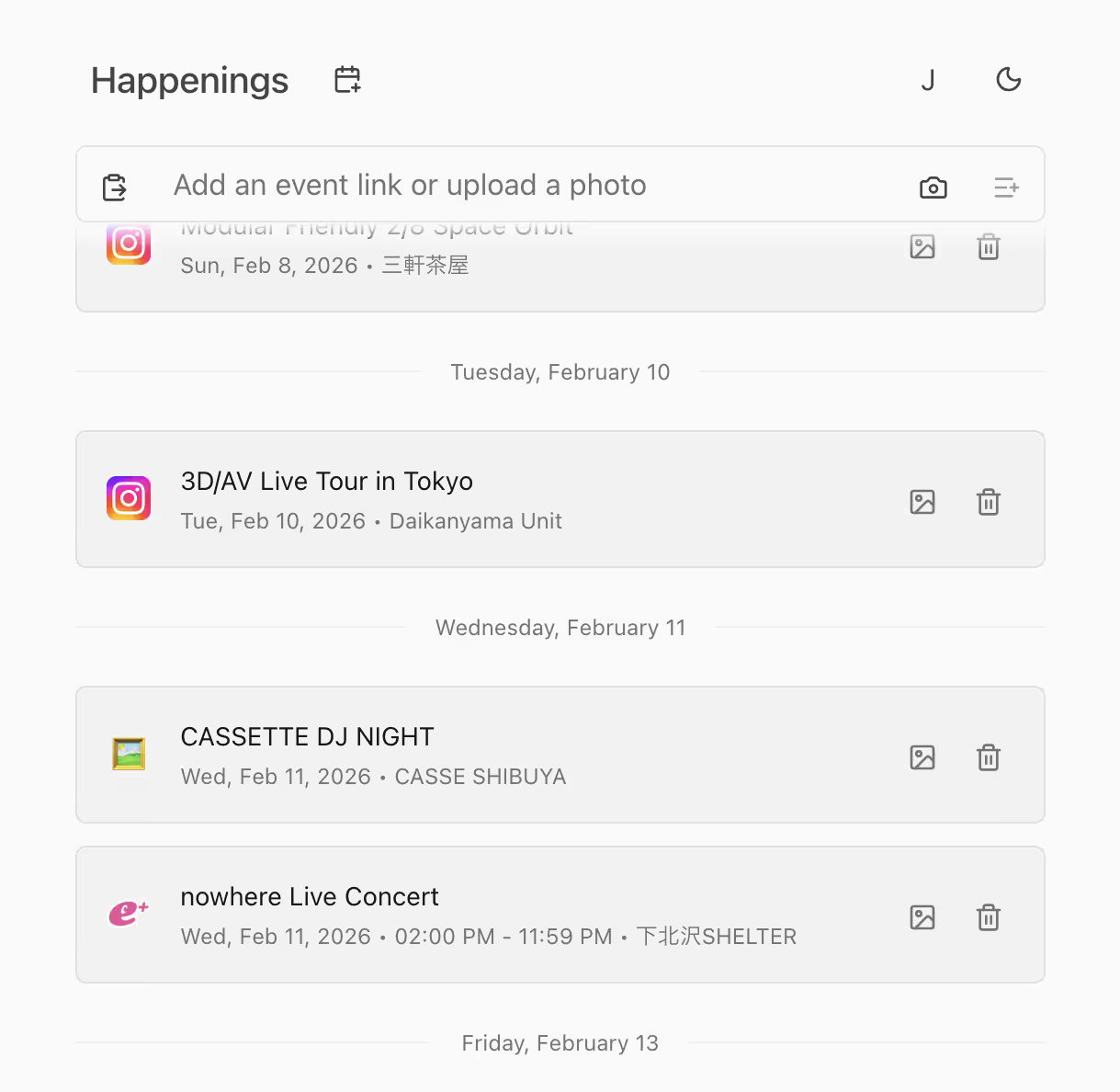
Happenings is a simple web app that allows the user to paste a link or drop a photo and get their event details at a glance. It doesn't matter which site you posted it from, whether its only occurring once or will will last a few weeks. Happenings provides a quick way to see which events you're interested in at a glance. Most importantly, it avoids a second or third click just to remember what that link or photo was about.
The reason most of this works so robustly is of course due to language models. The page or photo is cleaned up and transported over to be parsed by an LLM with a structured output that matches the fields we want for the date, details, etc. While the core of the app relies on this idea, that the details any site or photo can be quickly made intelligible, I have a lot of hesitations on AI and its use and mis-use.
A disclaimer: The hype and consequential investment of capital and environmental resources into AI is atrocious. And much like every major technological advancement, it has been immediately integrated into systems to imprison and kill human beings. That said, technology has the capacity for good. The discovery of the architecture of large language models can be incredibly helpful, alleviate burden, and likely advance fields that do real work for humans. These are always questions of use, misuse, and who makes and owns these tools. Technology itself can be transformational - but be careful if someone says this while selling you something.
For me, the pace and ability to iterate on small ideas has dramatically expanded. I don't doubt for a second that the lack of friction has resulted in a tradeoff I've just been incrementally working on it over the past year, as well as learning how to work with an AI agent in a way that's sustainable and understandable.
Less scrolling, more happenings
Some nice details:
- You can subscribe to the events you add (click the calendar button)
- Edit incorrect/missing event details by expanding and clicking "edit" (these will reparse dates or locations)
- Your browser's language and timezone are considered when parsing an event
- If a site doesn't work (some pages load details via JS), take a screenshot of the page and paste it in!
You can check out, make an account and use Happenings here, anywhere you have access to the web:
For now, the amount of credits needed to parse pages is generally so low (I can't imagine most people would make more than 30 requests a month) its actually easily covered by most free tiers. I've opted for Groq or Cerebras for fast inference on open models. However, I'd likely move to a provider like GreenPT or research alternatives that support green approaches to this. Or better yet, host from solar :) but that's for another post.
Please keep in mind that with the somewhat silly authentication system nothing should be assumed to be super private - though all that is ever posted here is public events so it feels more ok.